Which CRICOS Providers Have the Most Courses? Top 10 Institutions by Course Count
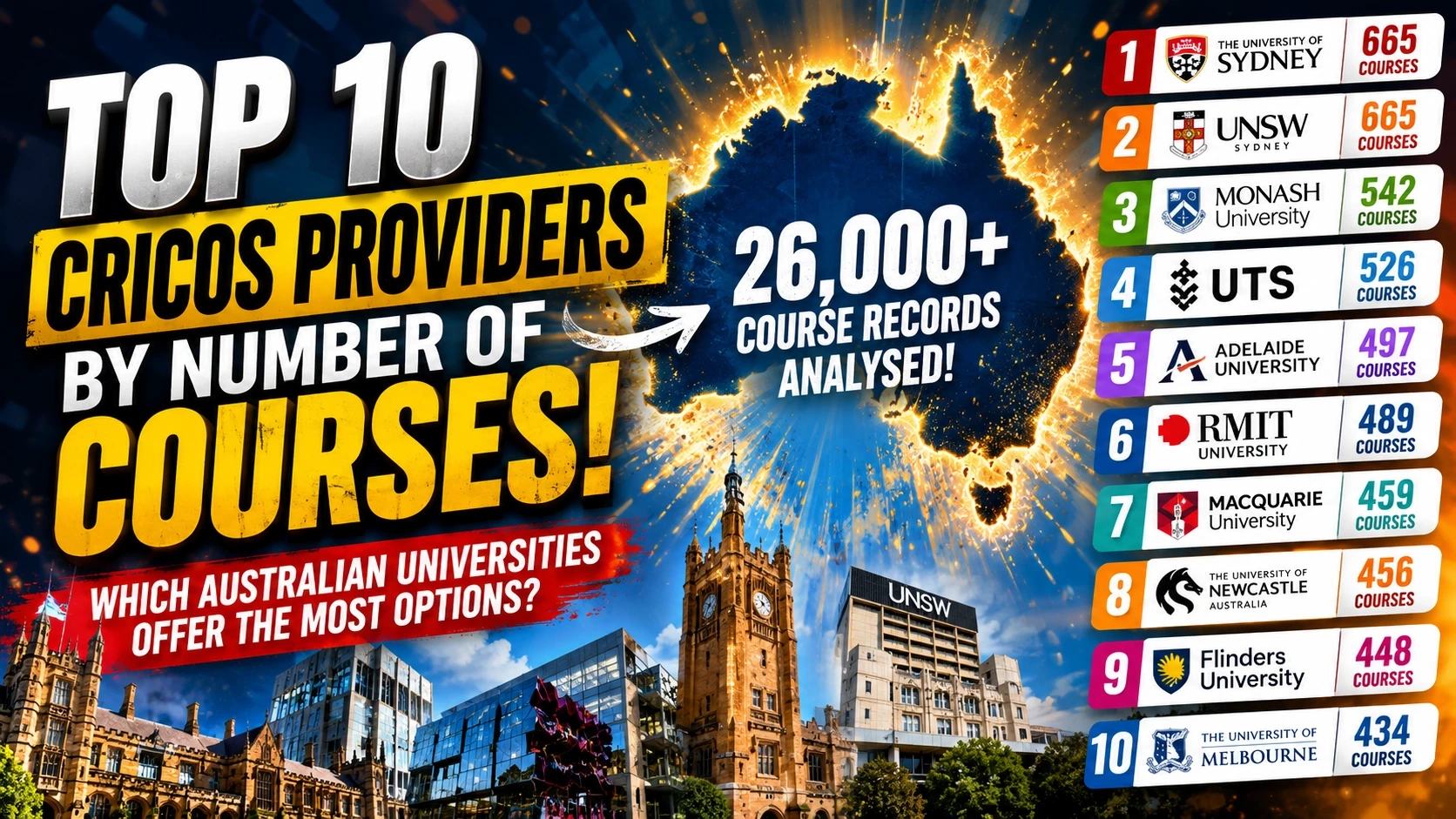
Australia’s CRICOS database contains thousands of registered courses for international students, but not every provider offers the same breadth of study options. Based on the current CRICOS course dataset analysed for this article, the providers with the largest number of listed courses are mostly major Australian universities, led by The University of Sydney and The University of New South Wales, each with 665 course records.
For students, agents, and researchers, this matters because course volume can indicate how broad an institution’s international offering is. A provider with hundreds of CRICOS-listed courses may offer more pathways across undergraduate degrees, postgraduate programs, research degrees, English language preparation, and specialist qualifications.
What this ranking shows
This ranking is based on the number of course records listed for each CRICOS provider in the analysed course database.
In simple terms:
1 course record = 1 listed CRICOS course attached to a provider
The ranking does not claim that one provider is “better” than another. It only shows which providers have the largest number of CRICOS-listed course records in the dataset.
That distinction is important. A smaller provider may specialise in one field and still be an excellent option for a particular student. A larger provider simply has a broader listed course catalogue.
Top 10 CRICOS providers by number of courses
| Rank | CRICOS Provider Code | Provider / Institution | Number of Courses |
| 1 | 00026A | The University of Sydney | 665 |
| 2 | 00098G | The University of New South Wales (UNSW) | 665 |
| 3 | 00008C | Monash University (Monash) | 542 |
| 4 | 00099F | University of Technology Sydney (UTS) | 526 |
| 5 | 04249J | Adelaide University | 497 |
| 6 | 00122A | Royal Melbourne Institute of Technology | 489 |
| 7 | 00002J | Macquarie University (Macquarie) | 459 |
| 8 | 00109J | The University of Newcastle (UoN) | 456 |
| 9 | 00114A | Flinders University | 448 |
| 10 | 00116K | The University of Melbourne (UniMelb) | 434 |
1. The University of Sydney — 665 courses
CRICOS Provider Code: 00026A
The University of Sydney is one of the two largest providers in this dataset by number of CRICOS course records. With 665 listed courses, it has one of the broadest international course catalogues in Australia.
For students, this means the provider may appear in many searches across different study levels and disciplines. A large number of CRICOS-listed courses also makes accurate filtering especially important: searching only by provider name may return too many results unless the student also filters by level, field of education, location, or course code.
2. The University of New South Wales — 665 courses
CRICOS Provider Code: 00098G
The University of New South Wales, often known as UNSW, also has 665 course records in the analysed dataset. This places it level with The University of Sydney at the top of the ranking.
For international students comparing major universities in New South Wales, UNSW is likely to appear across a wide range of CRICOS searches. Students should always check the exact course title, CRICOS course code, duration, location, and current registration status before making decisions.
3. Monash University — 542 courses
CRICOS Provider Code: 00008C
Monash University ranks third with 542 listed CRICOS courses. This is a very large catalogue and reflects a broad range of study options for international students.
Because Monash appears under a high number of course records, students should avoid relying only on the provider name. A more precise search by course keyword, study area, city, or CRICOS code is usually more useful.
4. University of Technology Sydney — 526 courses
CRICOS Provider Code: 00099F
University of Technology Sydney, commonly known as UTS, has 526 course records in the analysed database.
UTS is another example of a provider where the course catalogue is large enough that simple browsing is inefficient. Students looking for a specific program should search by exact course name or use filters to narrow the results.
5. Adelaide University — 497 courses
CRICOS Provider Code: 04249J
Adelaide University appears in fifth place with 497 course records.
This is a notable result because it places the provider among the largest CRICOS-listed institutions by course count in the analysed dataset. For students interested in South Australia, this provider may appear frequently across course searches, depending on field and study level.
6. Royal Melbourne Institute of Technology — 489 courses
CRICOS Provider Code: 00122A
Royal Melbourne Institute of Technology, commonly associated with RMIT, has 489 CRICOS course records in the dataset.
A provider with this many listed courses can cover a wide range of qualifications and study areas. For international students, the practical step is to compare individual course records carefully rather than treating the provider’s full catalogue as one single option.
7. Macquarie University — 459 courses
CRICOS Provider Code: 00002J
Macquarie University has 459 listed courses, placing it seventh in this ranking.
For students comparing providers in and around Sydney, Macquarie may appear across many different CRICOS course searches. As always, the exact course code and registration details matter more than the general provider name.
8. The University of Newcastle — 456 courses
CRICOS Provider Code: 00109J
The University of Newcastle has 456 course records in the analysed dataset.
This places it close to Macquarie University by course volume. For international students, a catalogue of this size means there may be multiple similar-looking course names, different qualification levels, and potentially different delivery locations.
9. Flinders University — 448 courses
CRICOS Provider Code: 00114A
Flinders University appears in ninth place with 448 CRICOS-listed courses.
This is another strong example of a provider with a broad international course offering. Students should check whether the course they are interested in is available at the correct campus and whether the registration details match their intended study plan.
10. The University of Melbourne — 434 courses
CRICOS Provider Code: 00116K
The University of Melbourne closes the top 10 with 434 course records.
Even at rank ten, the number of listed courses is substantial. This shows how concentrated the largest CRICOS course catalogues are among major Australian higher education providers.
Why course count matters when using CRICOS data
Course count is useful, but it should not be misunderstood.
A high number of CRICOS-listed courses can suggest:
- a broad international student catalogue;
- many qualification levels;
- multiple faculties or study areas;
- many active course options;
- a stronger chance that students will need filters to find the right result.
However, course count does not automatically mean:
- better teaching quality;
- cheaper tuition;
- easier admission;
- better visa outcomes;
- better employability;
- the best option for every student.
CRICOS is a registration system. It helps verify whether a course is officially registered for international students, but students still need to compare entry requirements, fees, location, duration, intake dates, and career relevance.
Why a searchable CRICOS tool is more useful than a raw course list
The analysed dataset contains 26,374 course records. That is too large for manual browsing.
A simple list of CRICOS courses may technically contain the information, but it is not practical for real users. Students usually need to answer specific questions, such as:
- Is this course registered for international students?
- What is the CRICOS course code?
- Which provider offers this course?
- Is the provider code correct?
- Which city or campus is attached to the course?
- Are there similar courses from other providers?
- How many options exist in a particular study field?
This is why search and filtering are essential. A useful CRICOS search experience should let users move from a general query to a precise course record quickly.
For example, instead of scrolling through thousands of rows, a student should be able to search by:
- provider name;
- CRICOS provider code;
- course name;
- CRICOS course code;
- city or location;
- field of study;
- qualification level.
What students should check before choosing a course
A CRICOS course record is only one part of the decision. Before choosing a course, international students should check several details carefully.
1. CRICOS course code
The CRICOS course code identifies a specific registered course. Students should check that the code matches the exact course they plan to study.
2. CRICOS provider code
The provider code identifies the institution. This is especially useful when providers have similar names or when a course is delivered through different entities.
3. Course title
Students should compare the exact title, not only the general subject area. Two courses may sound similar but lead to different qualifications.
4. Location
A course may be registered at a specific campus or location. This matters for accommodation, travel, work opportunities, and student lifestyle.
5. Duration
Course duration affects total tuition cost, visa planning, accommodation budget, and long-term study strategy.
6. Current status
Students should always check whether a course is currently active and suitable for international enrolment.
Key takeaway
The largest CRICOS providers by number of course records are major Australian universities with very broad international offerings. In the analysed dataset, The University of Sydney and The University of New South Wales lead the ranking with 665 courses each, followed by Monash University, University of Technology Sydney, Adelaide University, RMIT, Macquarie University, The University of Newcastle, Flinders University, and The University of Melbourne.
For students, the practical lesson is simple: CRICOS data is valuable, but only when it is searchable. With more than 26,000 course records, a proper CRICOS course search tool is far more useful than a static list.