139 New CRICOS Courses in September 2026: Levels, Fields and Notable Programs
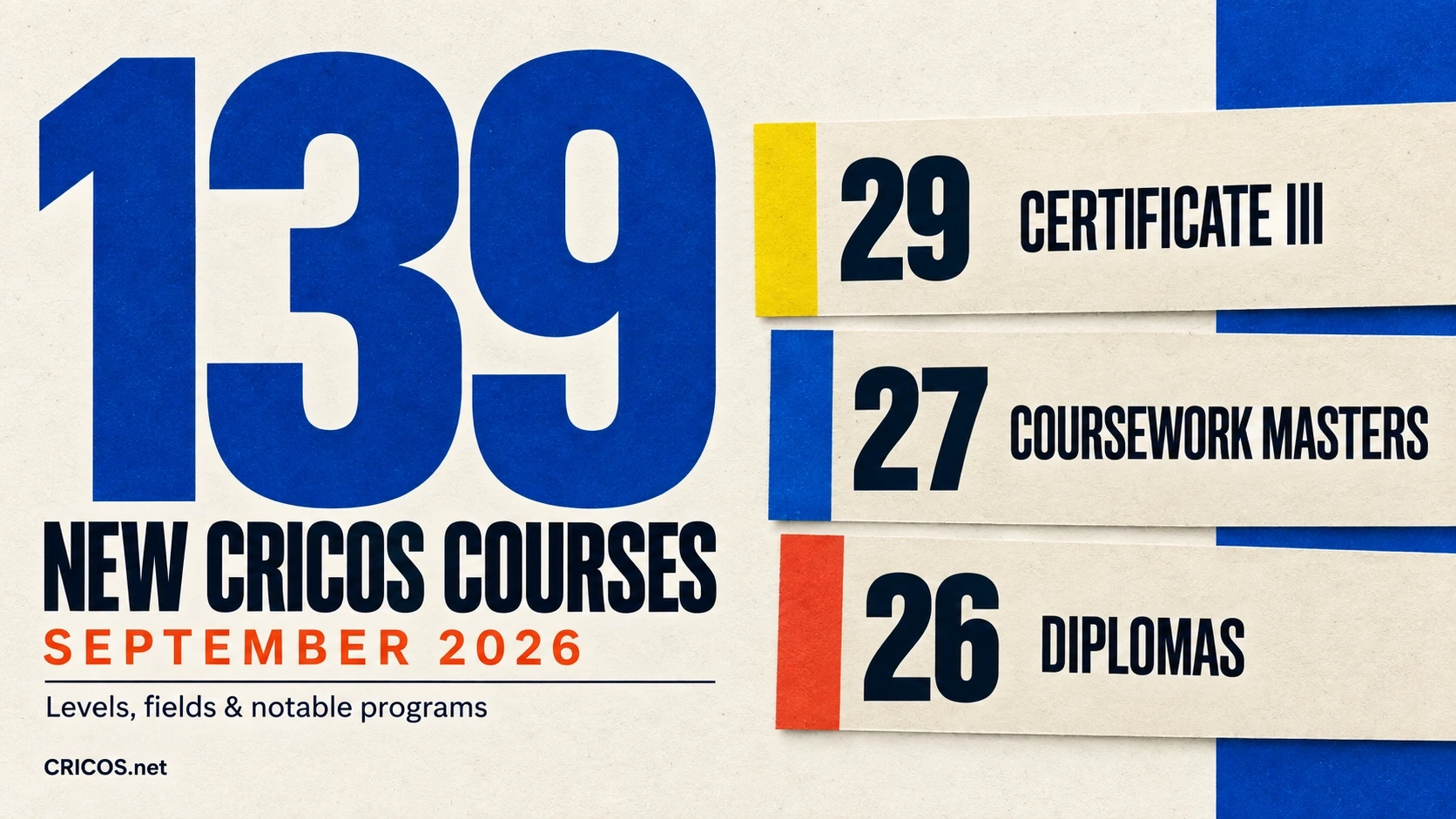
CRICOS.net’s comparison of the August and September 2026 course datasets identified 139 newly appearing provider-course registrations. Certificate III led the qualification levels with 29 additions, followed by coursework master’s degrees with 27 and diplomas with 26. Together, these three levels accounted for 59.0% of additions.
Architecture and Building was the largest primary field, also with 29 registrations. Five newly appearing course titles explicitly mentioned Artificial Intelligence, spanning business, computing and engineering classifications.
Here, “new” means that a provider-code/course-code combination appeared in the September dataset but was absent from the August snapshot. It does not establish that a course was first announced, began teaching or opened applications in September.
New CRICOS courses by qualification level
The 139 additions covered 13 course-level categories. The table preserves the level labels used in the dataset.
| Course level | New registrations | Share of additions |
| Certificate III | 29 | 20.9% |
| Masters Degree (Coursework) | 27 | 19.4% |
| Diploma | 26 | 18.7% |
| Bachelor Degree | 22 | 15.8% |
| Bachelor Honours Degree | 11 | 7.9% |
| Graduate Diploma | 5 | 3.6% |
| Advanced Diploma | 4 | 2.9% |
| Graduate Certificate | 4 | 2.9% |
| Certificate IV | 4 | 2.9% |
| Associate Degree | 3 | 2.2% |
| Non AQF Award | 2 | 1.4% |
| Doctoral Degree | 1 | 0.7% |
| Primary School Studies | 1 | 0.7% |
| Total | 139 | 100.0% |
Source: CRICOS.net analysis of the August–September 2026 datasets. Percentages use 139 additions as the denominator and are rounded independently.
Certificate III led coursework master’s degrees by only two registrations. The additions therefore included substantial activity at both certificate and postgraduate levels, rather than being concentrated in one qualification type.
Bachelor and Bachelor Honours registrations together contributed 33 additions, or 23.7% of the total. These counts describe registered course records, not student places, enrolments or the number of distinct subjects being taught.
New courses by primary field of education
Architecture and Building accounted for 20.9% of additions. Society and Culture followed with 23 records, while Management and Commerce contributed 17.
| Primary broad field | New registrations | Share of additions |
| Architecture and Building | 29 | 20.9% |
| Society and Culture | 23 | 16.5% |
| Management and Commerce | 17 | 12.2% |
| Health | 12 | 8.6% |
| Information Technology | 11 | 7.9% |
| Creative Arts | 10 | 7.2% |
| Engineering and Related Technologies | 10 | 7.2% |
| Education | 9 | 6.5% |
| Natural and Physical Sciences | 8 | 5.8% |
| Agriculture, Environmental and Related Studies | 5 | 3.6% |
| Mixed Field Programmes | 5 | 3.6% |
| Total | 139 | 100.0% |
Source: CRICOS.net analysis. Each registration is counted once using Field of Education 1. Rounded percentages may not sum to exactly 100%.
The field classification and qualification level describe different aspects of the same record. For example, a coursework master’s degree can appear under Health, Information Technology or Management and Commerce.
A combined degree may also carry a second field. Counting both fields would give some registrations more weight than others, so the headline distribution uses only the primary classification.
Building accounted for 26 additions
Within Architecture and Building, the narrower Building category contributed 26 registrations, equivalent to 18.7% of all September additions. The remaining three records in the broad category were classified under Architecture and Urban Environment.
Tradie Skills College, provider code 04201C, contributed six Building registrations:
- Certificate III in Wall and Floor Tiling — 121218J
- Certificate III in Solid Plastering — 121219H
- Certificate III in Bricklaying and Blocklaying — 121220D
- Certificate III in Glass and Glazing — 121221C
- Certificate III in Wall and Ceiling Lining — 121222B
- Certificate IV in Building and Construction — 121223A
Realm Vista Pty Ltd, provider code 04221K, contributed another six Building registrations. These covered painting and decorating, carpentry, tiling, glazing, solid plastering and a Diploma of Building and Construction.
Together, the two providers accounted for 12 of the 26 Building additions, or 46.2%.
These are additions to the monthly comparison, not a measure of net growth across the entire Building category. Establishing net change would also require counting Building records that disappeared between the snapshots. The additions alone do not demonstrate labour shortages or increased student demand.
Five newly listed titles explicitly mentioned artificial intelligence
A title-based check identified five additions containing the phrase Artificial Intelligence. They comprised two Bachelor Degree records, one Bachelor Honours Degree and two coursework master’s degrees.
| CRICOS code | Provider | Course | Published duration |
| 121233K | Bond University | Bachelor of Commerce / Bachelor of Enterprise Artificial Intelligence | 144 weeks |
| 121234J | Bond University | Bachelor of Enterprise Artificial Intelligence / Bachelor of Laws | 198 weeks |
| 121271D | La Trobe University | Bachelor of Artificial Intelligence Engineering (Honours) | 208 weeks |
| 121296F | Royal Melbourne Institute of Technology | Master of Artificial Intelligence | 104 weeks |
| 121299C | Royal Melbourne Institute of Technology | Master of Data Science and Artificial Intelligence | 104 weeks |
Source: September 2026 records in CRICOS.net’s additions dataset. Provider names are shortened where appropriate; CRICOS codes identify the registrations.
The two Bond titles combine AI with commerce or law. La Trobe’s title identifies an engineering honours program, while the two RMIT records are specialised master’s degrees.
These are distinctions visible in the registration data. Curriculum, entry requirements and professional recognition need to be checked in the provider’s course documentation.
CRICOS.net’s earlier analysis of 12 AI and machine-learning courses added in the August 2026 update covers the previous snapshot comparison. The September list above identifies additions in a separate reporting window.
Why AI courses do not all appear under Information Technology
The five AI titles are distributed across three primary broad fields:
| Primary broad field | AI-title additions |
| Information Technology | 3 |
| Management and Commerce | 1 |
| Engineering and Related Technologies | 1 |
Bond’s Commerce/Enterprise Artificial Intelligence degree is classified primarily under Management and Commerce, with Information Technology as its second field. Its Enterprise Artificial Intelligence/Laws degree has Information Technology as the primary field.
La Trobe’s Artificial Intelligence Engineering degree is classified under Engineering and Related Technologies. Both RMIT master’s degrees have Information Technology as their primary field.
Consequently, filtering only the 11 Information Technology additions would miss two of the five explicitly AI-named programs. A subject search should examine course titles and secondary classifications as well as the primary field.
Published tuition needs a separate comparison
The September snapshot lists tuition of A$200,320 and A$275,440 for the two Bond registrations, A$44,800 for La Trobe’s AI engineering degree, and A$96,000 for each RMIT master’s degree.
These are the values recorded in the export, not independently verified current offers. In particular, the A$44,800 value alongside La Trobe’s 208-week duration needs clarification of the fee period before it is compared with the other amounts.
The table therefore avoids an affordability ranking or annualised fee calculation. Students should confirm the period covered, compulsory additional charges and applicable intake with each provider.
Health additions included midwifery, audiology and occupational therapy
The Health broad field contributed 12 new registrations. Examples show several distinct study areas:
| CRICOS code | Provider | Course |
| 121283M | Federation University Australia | Bachelor of Midwifery |
| 121281B | Charles Darwin University | Master of Clinical Audiology |
| 121209K | Curtin University | Bachelor of Health Sciences |
| 121294H | Royal Melbourne Institute of Technology | Bachelor of Occupational Therapy (Honours) |
Source: September 2026 additions dataset.
Course titles are not a substitute for field classifications. A health-related name may describe clinical study, management or another discipline, and the record’s primary field determines where it appears in the aggregate table.
For example, the additions also include Flinders University’s Graduate Diploma in Health Management and Leadership, code 121290A, and two master’s records with the same subject focus: 121291M and 121292K. The latter two titles specify 1.5-year and 2-year versions respectively.
Those separate CRICOS codes are counted as separate registrations. Their relationship should be checked with the provider before treating them as interchangeable study options.
Sustainability and planning crossed field boundaries
Curtin University’s additions included four registrations classified under Environmental Studies:
| CRICOS code | Course | Published duration |
| 121216M | Graduate Certificate in Planning for Sustainability | 26 weeks |
| 121213C | Graduate Diploma in Sustainability and Climate Leadership | 52 weeks |
| 121206B | Master of Applied Science (Sustainability and Climate Leadership) | 78 weeks |
| 121214B | Master of Sustainability and Climate Leadership | 104 weeks |
Curtin also accounted for all three additions classified under Architecture and Urban Environment:
- Master of Urban and Regional Planning — 121207A
- Master of Applied Science (Urban and Regional Planning) — 121208M
- Bachelor of Urban and Regional Planning (Honours) — 121215A
This grouping illustrates how related topics can sit in different parts of the classification system. A student researching sustainability may find relevant titles under environmental studies, planning or other fields.
The sequence of certificate, diploma and master’s titles does not establish an automatic progression pathway. Credit transfer and articulation arrangements require separate confirmation from the university.
September had fewer additions than August
The August 2026 CRICOS update identified 250 additions compared with July. The September comparison identified 139 compared with August: 111 fewer additions, a decline of 44.4% in the monthly addition count.
| Measure | August update | September update |
| All newly appearing registrations | 250 | 139 |
| Certificate III additions | 65 | 29 |
| Certificate III share | 26.0% | 20.9% |
| Coursework master’s additions | 22 | 27 |
| Coursework master’s share | 8.8% | 19.4% |
| Architecture and Building additions | 65 | 29 |
Coursework master’s registrations increased from 22 to 27 even as the overall addition count fell. Their share rose by 10.6 percentage points, reflecting both the larger master’s count and the smaller total.
Architecture and Building led both updates. However, September was not more concentrated in Building than August: the previous update’s 65 Architecture and Building additions were all classified in the Building narrow field, compared with 26 of 29 in September.
The overall register also had 814 disappearing provider-course keys in the September comparison. Together with 139 additions, that produced a net reduction of 675 records. This does not mean that 675 courses closed; disappearance from a snapshot requires separate investigation.
Using the additions list to research a course
The list is useful for finding registrations to investigate. It does not confirm that applications are open or that a particular campus offers the next intake.
Search the exact code in the Australian Government CRICOS course search, then check the provider’s current course information.
For a shortlist, record the qualification level, primary and secondary fields, registered duration, delivery location, fee period and entry requirements. For combined degrees, review both named disciplines. For related qualifications at one provider, confirm whether progression or credit arrangements actually exist.
Methodology
CRICOS.net compared the August and September 2026 course datasets using CRICOS Provider Code + CRICOS Course Code as the matching key.
A registration was classified as newly appearing when its key was absent from August and present in September. The resulting additions file contains 139 rows and 139 distinct composite keys.
Qualification levels, fields, course names, durations and tuition values were taken from the September records. The level and broad-field distributions each sum to 139. Shares use 139 as the denominator and are rounded to one decimal place.
Field totals use Field of Education 1. Secondary fields are discussed where relevant but are not added to the headline counts. The AI subset uses an explicit Course Name search for “Artificial Intelligence”; it is not a count of every course that may teach AI.
Provider and course examples were checked against CRICOS.net’s saved additions CSV. The monthly figures are CRICOS.net’s analysis of the snapshots, not official government conclusions about education demand or course launches. Live records and provider offers may have changed since the September export.