CRICOS September 2026 Update: 139 Courses Added, 814 Removed and 825 Records Changed
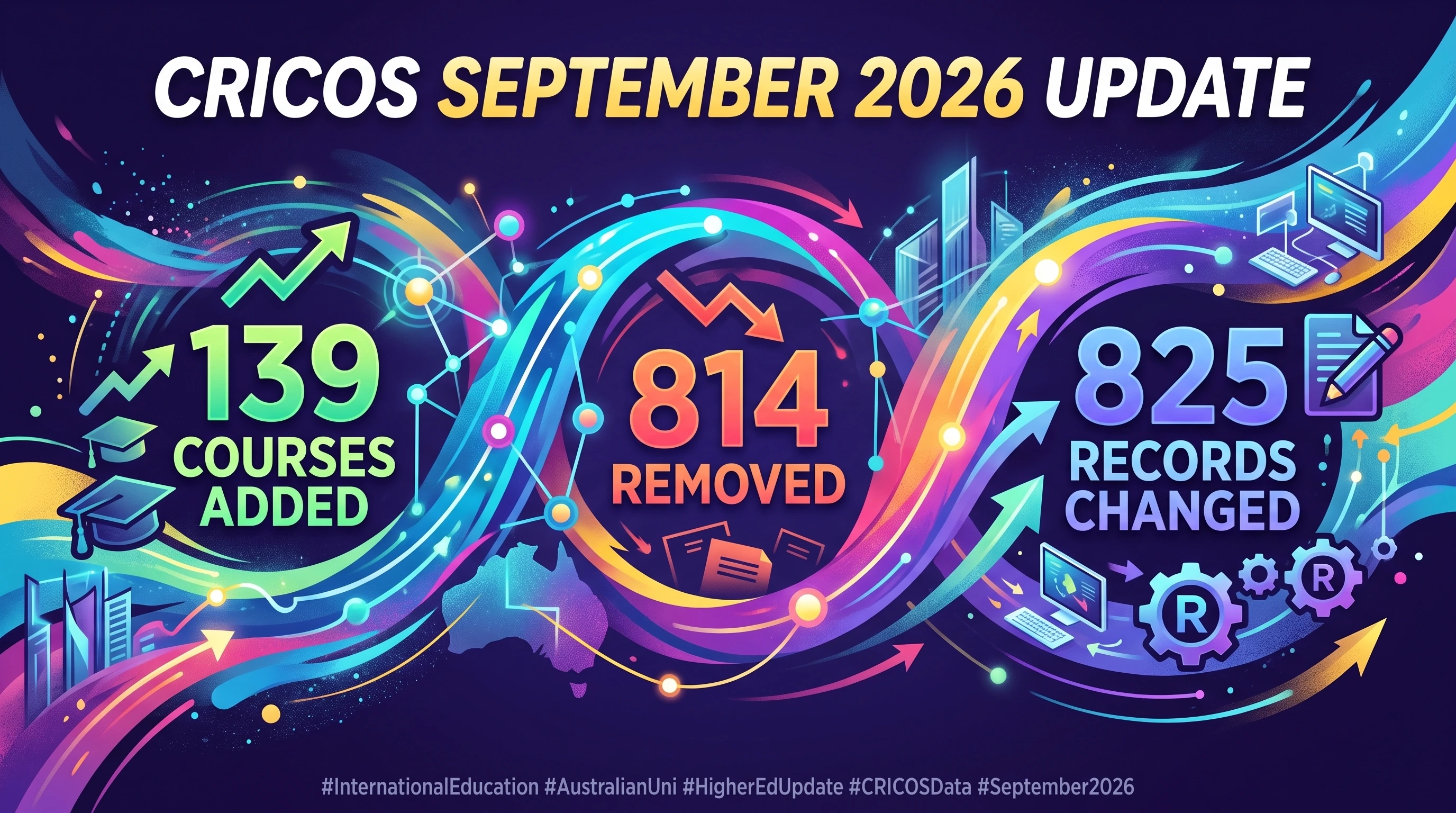
The September 2026 CRICOS course export contained 675 fewer valid provider-course records than the August snapshot. CRICOS.net identified 139 newly appearing course registrations, 814 registrations no longer present and 825 continuing records with at least one changed field.
The headline contraction was highly concentrated. The provider codes belonging to the University of South Australia and the University of Adelaide accounted for 685 of the 814 removed records, or 84.2%.
If those two legacy provider codes are set aside, the remainder of the comparison contains 139 additions and 129 removals - a net increase of 10 course records. The national decline therefore does not represent a uniform reduction across Australian providers.
These findings describe differences between two CRICOS data exports. They do not measure enrolments, applications, commencements, student demand or education quality. A registration absent from the later file should not automatically be described as a course cancelled during September.
September 2026 CRICOS changes at a glance
| Metric | Result |
| Valid course records in August | 26,738 |
| Valid course records in September | 26,063 |
| Net change | -675 |
| Newly appearing provider-course keys | 139 |
| Provider-course keys no longer present | 814 |
| Keys present in both snapshots | 25,924 |
| Continuing records with a changed field | 825 |
| Continuing records with no detected change | 25,099 |
| Records with a Tuition Fee change | 627 |
| Records with an Estimated Total Course Cost change | 629 |
The valid-record count fell by approximately 2.5%:
26,738 August records + 139 additions - 814 removals = 26,063 September records
The two source files contained 26,740 and 26,065 rows respectively. Each included two fully blank rows at the end. CRICOS.net excluded those rows before calculating course totals and found no duplicate non-blank combinations of provider code and course code.
How CRICOS.net identified course changes
The comparison used this composite identifier:
CRICOS Provider Code + CRICOS Course Code
A course was classified as:
- Added when its provider-code/course-code combination appeared in September but not August.
- Removed when the combination appeared in August but not September.
- Continuing when the same combination appeared in both snapshots.
- Changed when a continuing record contained at least one different exported field.
The provider code is necessary because similar course names can appear at different institutions. Matching by course title alone could incorrectly combine unrelated registrations.
“Added” means newly appearing in the September snapshot. It does not establish that the program itself was created in September or that this was the first month it was marketed.
“Removed” means no longer present under the same composite key. The export does not state whether the reason was expiry, replacement, a provider transition, a different registration code or a data correction.
Curtin University recorded the most additions
Curtin University had the largest number of newly appearing registrations, with 11. Realm Vista Pty Ltd followed with nine, while the Royal Melbourne Institute of Technology recorded eight.
The ten providers with the most additions accounted for 66 of the 139 new records, or 47.5%.
| Rank | Provider | Provider code | Added records |
| 1 | Curtin University | 00301J | 11 |
| 2 | Realm Vista Pty Ltd | 04221K | 9 |
| 3 | Royal Melbourne Institute of Technology | 00122A | 8 |
| 4 | Flinders University | 00114A | 7 |
| 5 | Tradie Skills College | 04201C | 6 |
| 6 | Charles Darwin University | 00300K | 5 |
| 6 | Federation University Australia | 00103D | 5 |
| 6 | JMC Pty Limited | 01259J | 5 |
| 6 | The Academy of Business and Management Australia Pty Ltd | 04360K | 5 |
| 6 | Torrens University Australia Limited | 03389E | 5 |
The additions covered both higher education and vocational training. Examples from the September-only records include:
| Provider | CRICOS course code | Course | Level |
| Royal Melbourne Institute of Technology | 121296F | Master of Artificial Intelligence | Masters Degree (Coursework) |
| Curtin University | 121214B | Master of Sustainability and Climate Leadership | Masters Degree (Coursework) |
| Federation University Australia | 121283M | Bachelor of Midwifery | Bachelor Degree |
| Tradie Skills College | 121220D | Certificate III in Bricklaying and Blocklaying | Certificate III |
These examples demonstrate the range of registrations entering the snapshot. Their appearance does not establish enrolment demand, application volumes or the availability of a particular intake.
Two Adelaide provider codes dominated removals
The University of South Australia recorded 344 provider-course keys that appeared in August but not September. The University of Adelaide recorded 341.
| Provider | Provider code | Removed records | Share of all removals |
| University of South Australia | 00121B | 344 | 42.3% |
| University of Adelaide | 00123M | 341 | 41.9% |
| Intech Institute of Technology Pty Ltd | 02035F | 46 | 5.7% |
| Australian Adelaide International College Pty Ltd | 03126F | 20 | 2.5% |
| NEWTON COLLEGE PTY. LTD. | 03598G | 18 | 2.2% |
| International College of Tasmania Pty Ltd | 03683K | 10 | 1.2% |
| MYOZ College Pty Ltd | 03795B | 8 | 1.0% |
The two largest groups of removals occurred in the context of the transition to Adelaide University. The new institution officially opened on 5 January 2026 and identifies the University of South Australia and the University of Adelaide as its foundation institutions.
That institutional transition provides relevant context, but it does not establish the reason for every disappearing CRICOS key. The monthly files do not include removal explanations or a one-to-one mapping between each legacy registration and an Adelaide University replacement.
The 685 records should therefore be described as registrations absent from the September snapshot under the two legacy provider codes - not as 685 confirmed course cancellations.
Bachelor and postgraduate registrations recorded the largest net declines
Bachelor Degree was the largest declining course level, with 145 fewer records in September. Masters Degree (Coursework) declined by 105, while Bachelor Honours Degree fell by 95.
| Course level | August records | September records | Net change |
| Bachelor Degree | 4,023 | 3,878 | -145 |
| Masters Degree (Coursework) | 3,395 | 3,290 | -105 |
| Bachelor Honours Degree | 1,556 | 1,461 | -95 |
| Masters Degree (Research) | 854 | 783 | -71 |
| Doctoral Degree | 948 | 881 | -67 |
| Graduate Diploma | 1,558 | 1,495 | -63 |
| Non AQF Award | 1,758 | 1,717 | -41 |
| Graduate Certificate | 1,071 | 1,038 | -33 |
Certificate III was one of the few levels with a positive net movement, increasing by four records. Associate Degree increased by one.
A net change combines additions and removals. It should not be read as the number of courses discontinued within that qualification level.
What types of courses were added?
Certificate III was the largest category among the 139 September-only records, followed by coursework master’s degrees and diplomas.
| Course level | Newly appearing records | Share of additions |
| Certificate III | 29 | 20.9% |
| Masters Degree (Coursework) | 27 | 19.4% |
| Diploma | 26 | 18.7% |
| Bachelor Degree | 22 | 15.8% |
| Bachelor Honours Degree | 11 | 7.9% |
| Graduate Diploma | 5 | 3.6% |
| Advanced Diploma | 4 | 2.9% |
| Graduate Certificate | 4 | 2.9% |
| Certificate IV | 4 | 2.9% |
| Associate Degree | 3 | 2.2% |
The four leading levels accounted for 104 additions, or 74.8% of all newly appearing registrations. This mix shows that the September additions were divided across university and vocational qualifications rather than concentrated in a single education sector.
825 continuing course records changed
After blank rows were excluded, 25,924 provider-course keys appeared in both snapshots. Of these, 825 - approximately 3.2% - changed in at least one exported field.
One course can contribute to several field counts, so the figures below do not add up to 825.
| Changed field | Continuing records affected |
| Estimated Total Course Cost | 629 |
| Tuition Fee | 627 |
| Non Tuition Fee | 346 |
| Duration (Weeks) | 76 |
| Work Component Weeks | 72 |
| Work Component Total Hours | 70 |
| Work Component Hours/Week | 61 |
| Institution Name | 27 |
| Expired | 22 |
| Work Component | 20 |
| Course Name | 5 |
Fee-related fields dominated the changes. Estimated Total Course Cost changed in 629 records, Tuition Fee in 627 and Non Tuition Fee in 346.
A changed institution name does not necessarily indicate a transfer to a different legal provider because the provider code remained part of the matching key.
Most comparable tuition changes were increases
The Tuition Fee field changed for 627 continuing registrations:
- 604 comparable values increased.
- 18 comparable values decreased.
- Five previously blank fields gained a value.
These figures describe movements in the exported whole-course Tuition Fee field. They are not necessarily annual fee changes and should not be treated as personalised quotes.
The largest increase in the dataset was for St Paul’s Grammar School’s Primary program, CRICOS course code 041263D. Its published Tuition Fee field moved from A$176,722 to A$289,920, an increase of A$113,198.
The largest decrease was for the International Baccalaureate Primary Years Program offered by the Corporation of the Synod of the Diocese of Brisbane, course code 112749A. Its Tuition Fee field moved from A$291,624 to A$203,560, a decrease of A$88,064.
Large changes may reflect revised course duration, corrected data, a new cost basis or another administrative update. The two snapshots cannot establish the cause. Students should verify current fees, duration and intake conditions with the provider before relying on an exported amount.
What the September update shows
The comparison produces three evidence-based findings:
- The 675-record contraction was concentrated rather than market-wide. University of South Australia and University of Adelaide provider codes accounted for 84.2% of removed registrations. Outside those two groups, additions exceeded removals by 10.
- New registrations continued to appear at different qualification levels. Certificate III, coursework master’s, diploma and bachelor registrations together represented almost three-quarters of additions.
- Changes to existing records were more common than new listings. The analysis found 825 changed continuing records compared with 139 additions. Fee fields accounted for most of the detected updates.
These observations describe register activity, not student behaviour. The comparison cannot show whether applications increased, whether a qualification became more popular or why a provider changed a particular record.
What students and education advisers should verify
A monthly snapshot comparison is useful for detecting changes, but the current record remains the relevant reference for an application or payment decision.
Check:
- The live CRICOS course code
- The registered provider
- Current course duration
- Delivery locations
- Tuition and non-tuition fees
- Expiry information
- Intake availability
- Provider admission and payment conditions
The Australian Government’s live CRICOS register is the authoritative place to check current providers and courses. The Department of Education explains that institutions may enrol and deliver education services in Australia to student-visa holders only when they are appropriately registered on CRICOS.
CRICOS.net’s August 2026 update provides the preceding July-to-August comparison.
Methodology and limitations
CRICOS.net compared the August and September 2026 CRICOS course CSV snapshots.
The workflow was:
- Remove rows with no provider code and no course code.
- Use CRICOS Provider Code + CRICOS Course Code as the composite identifier.
- Confirm that no non-blank composite key was duplicated within either file.
- Classify keys found only in September as additions.
- Classify keys found only in August as removals.
- Compare all exported fields for keys present in both files.
- Parse monetary fields as Australian-dollar amounts while preserving published values for reporting.
- Calculate provider and course-level totals from the resulting groups.
The analysis measures differences between two exports. It does not identify the exact date of a database change, explain why a record changed or prove that an absent registration represents a cancelled course.
This is independent CRICOS.net analysis of publicly available CRICOS data, not an official Australian Government trend statement.