CRICOS FAQ 2026: Answers to the Most Common Questions About CRICOS, ELICOS, Providers and Courses
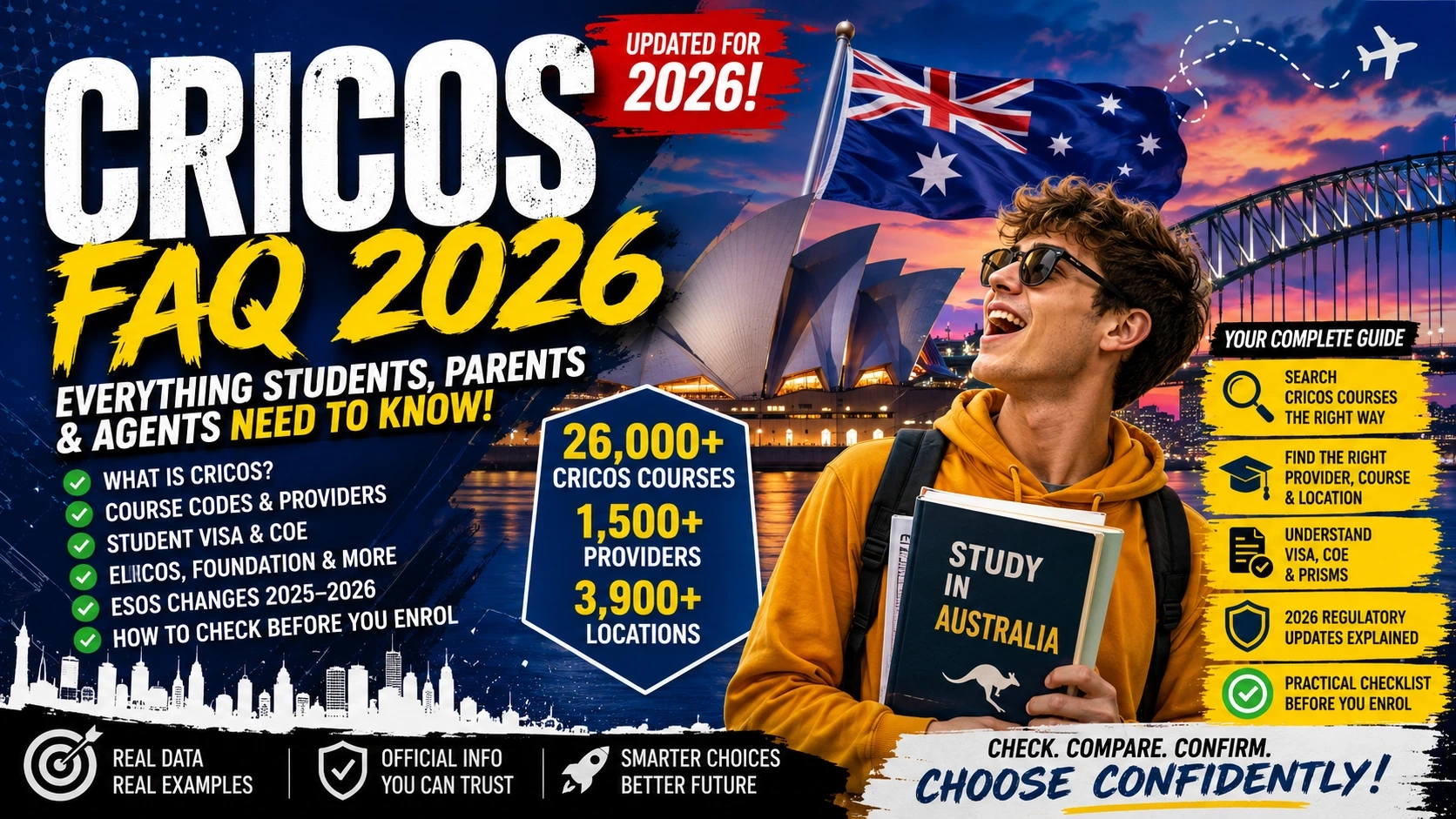
CRICOS is the official Australian Government register of education providers and courses approved for overseas students studying in Australia on student visas. In 2026, CRICOS remains one of the most important checks for international students, parents, education agents and providers because it shows whether a provider, course and study location are registered for overseas student enrolment. This FAQ explains what CRICOS means, how CRICOS course codes work, how ELICOS fits into the system, what students should check before enrolling, and why recent ESOS changes matter.
CRICOS stands for Commonwealth Register of Institutions and Courses for Overseas Students. The official CRICOS website is the Australian Government register that lists Australian education providers and registered courses for people studying in Australia on student visas.
This guide is not a replacement for official Australian Government, Department of Education, TEQSA, ASQA or immigration advice. It is a practical CRICOS FAQ designed to help students, parents, education agents and providers understand the system more clearly and check course information more efficiently.
CRICOS at a glance
CRICOS is not just a list of courses. It is a regulatory register connected to Australia’s international education system, student visa framework and provider compliance obligations.
According to the official TEQSA FAQ, CRICOS is the official register of Australian education providers that are permitted to offer courses to students studying in Australia on student visas. The TEQSA FAQ page itself was published or last updated in April 2023, which is why a fresh 2026 practical FAQ is useful for students and agents who need current context.
Based on the current CRICOS dataset used by CRICOS.net, the database contains:
| CRICOS dataset area | Current count in uploaded database |
| Course records | 26,435 |
| Active / non-expired course records | 26,347 |
| Institution records | 1,558 |
| Location records | 3,900 |
| Course-location rows | 46,787 |
These figures show why a simple static list is not enough. CRICOS data is large, detailed and location-dependent. A course can be linked to more than one campus, and a provider can have many registered courses across different study locations.
1. Basic CRICOS questions
What is CRICOS?
CRICOS is the Commonwealth Register of Institutions and Courses for Overseas Students. It is the official Australian Government register of education providers and courses approved for overseas students studying in Australia on student visas.
In practical terms, CRICOS helps answer three key questions:
| Question | Why it matters |
| Is the provider registered? | Students should check whether the institution is approved to enrol overseas students. |
| Is the course registered? | A course generally needs CRICOS registration if it is offered to student visa holders. |
| Is the location registered? | Students should check where the course is approved to be delivered. |
What does CRICOS stand for?
CRICOS stands for Commonwealth Register of Institutions and Courses for Overseas Students.
The name itself explains the function of the register:
- Commonwealth — it is part of the Australian Government system.
- Register — it records official provider and course information.
- Institutions and Courses — it covers both providers and the courses they offer.
- Overseas Students — it is specifically relevant to international students studying in Australia on student visas.
Is CRICOS an official government register?
Yes. CRICOS is an official Australian Government register. The official CRICOS website states that it lists all Australian education providers that offer courses to people studying in Australia on student visas, and the courses they offer.
This matters because students should not rely only on marketing pages, brochures or agent claims. Before paying a deposit or applying for a visa, the provider and course should be checked against CRICOS information.
Who needs to use CRICOS?
CRICOS is useful for several groups:
| User | Why CRICOS matters |
| International students | To check whether a course is registered for student visa purposes. |
| Parents | To verify that a provider and course are legitimate before paying fees. |
| Education agents | To confirm accurate course, provider and location information. |
| Providers | To manage registered courses, locations and compliance obligations. |
| Researchers and SEO/data users | To analyse Australian international education supply by provider, city, field or course level. |
Is CRICOS only for international students?
CRICOS is mainly relevant to overseas students studying in Australia on student visas. Domestic students usually do not need CRICOS for enrolment decisions.
However, CRICOS can still be useful more broadly because it provides structured public information about Australian education providers, courses and locations.
What is a CRICOS code?
A CRICOS code is an official code used in the CRICOS register. There are two common types:
| Code type | Example format | What it identifies |
| CRICOS provider code | 00001K | The registered education provider |
| CRICOS course code | 097541B | A specific registered course |
For example, in the current database, Canberra Institute of Technology appears with provider code 00001K, and one of its English courses appears with course code 097541B.
What is the difference between a CRICOS provider code and a CRICOS course code?
A CRICOS provider code identifies the education provider.
A CRICOS course code identifies a registered course.
For example:
| Provider code | Provider | Course code | Course |
| 00001K | Canberra Institute of Technology | 097541B | English for Study and Life (Elementary) |
| 00001K | Canberra Institute of Technology | 089976G | Diploma of Community Services |
The provider code tells you who offers the course. The course code tells you which specific course is registered.
Can one provider have many CRICOS courses?
Yes. One provider can have many CRICOS-registered courses.
This is normal for universities, TAFEs, colleges and English language providers. A large provider may have courses across multiple levels, fields and campuses.
Can one course be offered in several locations?
Yes. A CRICOS course can be linked to more than one registered location.
This is why students should check not only the course code and provider code, but also the location. The same or similar course may appear at different campuses, cities or states.
In the current uploaded CRICOS course-location database, there are 46,787 course-location rows, which shows how important location-level checking is.
2. CRICOS course search questions
How do I search for a CRICOS course?
You can search for a CRICOS course by using:
- course name;
- CRICOS course code;
- provider name;
- provider code;
- city;
- state;
- course level;
- field of education.
The official CRICOS website provides course and institution search functions.
A practical search tool such as CRICOS.net can make this easier by helping users filter and compare CRICOS data faster, especially when the database contains more than 26,000 course records.
How do I check if a CRICOS course code is valid?
To check a CRICOS course code, search the code in a CRICOS course search tool and confirm:
| Item to check | Why it matters |
| Course code | Confirms the specific course record. |
| Course name | Ensures the code matches the course you were offered. |
| Provider name | Confirms the institution offering the course. |
| Provider code | Helps avoid confusion between similarly named institutions. |
| Location | Confirms where the course is registered. |
| Expired status | Helps identify whether the course is still active. |
A valid-looking code is not enough. The course name, provider and location should also match.
Why is a plain list of CRICOS courses hard to use?
A plain list is difficult because CRICOS data is large and multi-dimensional.
Based on the current uploaded database, there are:
- 26,435 course records;
- 26,347 active/non-expired course records;
- 1,558 institution records;
- 3,900 location records;
- 46,787 course-location rows.
That means a user often needs filters, not just a list. A student may want to find “IT courses in Adelaide”, “ELICOS courses in Melbourne”, “Diploma courses in Brisbane”, or “courses from a specific provider code”. Without filters, this becomes inefficient.
What details should I check before choosing a CRICOS course?
Before choosing a CRICOS course, check:
| Detail | What to verify |
| Provider name | Does it match the institution you are applying to? |
| Provider code | Does the CRICOS provider code match official records? |
| Course code | Does the course code match the exact course? |
| Course name | Is it the same course listed in your offer? |
| Course level | Is it Certificate, Diploma, Bachelor, Master, ELICOS, Foundation or another level? |
| Duration | Does the course duration match your study plan? |
| Tuition fee | Does the fee align with the provider’s current offer? |
| Location | Is the campus or delivery location correct? |
| Expired status | Is the course still active in the dataset? |
CRICOS checking should be part of the decision process, not an afterthought.
Can a course be registered but not currently available to new students?
Yes, this is possible.
CRICOS registration means the course is listed in the register, but students should still confirm with the provider whether the course is currently open for new enrolments, whether the intake is available, and whether the campus location is accepting students for that course.
CRICOS is a registration check. It is not a guarantee that every course is open at every intake.
3. Student visa and enrolment questions
Why does CRICOS matter for a student visa?
CRICOS matters because the register is linked to courses offered to overseas students studying in Australia on student visas. The official CRICOS website describes it as the Australian Government site listing providers and courses for people studying in Australia on student visas.
For students, this means CRICOS is one of the first checks before enrolment. If a course is not properly registered for overseas students, it may not be suitable for a student visa pathway.
Can I apply for an Australian student visa without a CRICOS course?
For most international study pathways in Australia, students need to enrol in a CRICOS-registered course and receive a Confirmation of Enrolment.
There may be special cases depending on visa type, study arrangement or regulation, so students should check official visa guidance. But as a practical rule, if the purpose is to study in Australia on a student visa, CRICOS registration is central.
What is a Confirmation of Enrolment?
A Confirmation of Enrolment, usually called a CoE, is an official enrolment confirmation used in Australia’s international student system.
PRISMS, the Provider Registration and International Student Management System, provides Australian education providers with Confirmation-of-Enrolment facilities required for compliance with ESOS legislation.
What is PRISMS?
PRISMS stands for Provider Registration and International Student Management System.
It is used by Australian education providers for international student management and CoE-related processes. The official PRISMS site states that it provides CoE facilities required for compliance with ESOS legislation.
Students usually do not use PRISMS directly in the same way providers do. But students will encounter the result of PRISMS processes through their CoE.
Should I check CRICOS before paying a deposit?
Yes. Before paying a deposit, a student should check:
| Check | Why it matters |
| Provider is listed | Confirms the institution is registered for overseas students. |
| Course is listed | Confirms the specific course is registered. |
| Location is listed | Confirms the campus or delivery location. |
| Course code matches offer | Avoids confusion between similar courses. |
| Provider code matches offer | Avoids confusion between similarly named providers. |
| Course is not expired | Helps avoid outdated records. |
This is especially important when dealing with unfamiliar colleges, third-party agents or courses promoted heavily online.
What happens if my provider or course changes status?
If a provider or course changes status, students should contact the provider immediately and verify the situation through official sources.
Possible issues may include:
- course withdrawal;
- location changes;
- provider registration changes;
- intake changes;
- compliance actions;
- changes to course availability.
Students should not rely only on old PDFs, screenshots or cached pages. CRICOS information should be checked close to the time of enrolment.
4. ELICOS and Foundation questions
What is ELICOS?
ELICOS stands for English Language Intensive Courses for Overseas Students.
These are English language courses designed for overseas students. ELICOS courses are especially important for students who need English preparation before further study, or who want to study English in Australia under a student visa pathway.
Do ELICOS courses need to be on CRICOS?
If an ELICOS course is offered to overseas students studying in Australia on student visas, CRICOS registration is generally required.
TEQSA has specific CRICOS and ELICOS guidance, including information on how providers apply to add an ELICOS course to CRICOS. The TEQSA CRICOS section includes ELICOS-related registration guidance for providers.
What are examples of ELICOS-style courses in CRICOS data?
In the current uploaded CRICOS course database, English language course examples include:
| Provider code | Provider | Course code | Course name |
| 00001K | Canberra Institute of Technology | 097541B | English for Study and Life (Elementary) |
| 00001K | Canberra Institute of Technology | 097543M | English for Study and Life (Pre-Intermediate) |
| 00001K | Canberra Institute of Technology | 097544K | English for Study and Life (Intermediate) |
| 00001K | Canberra Institute of Technology | 097545J | English for Study and Life (Upper-Intermediate) |
| 00001K | Canberra Institute of Technology | 097546G | English for Study and Life (Advanced) |
| 00002J | Macquarie University | 097293B | English Language Program |
| 00003G | University of New England | 083280M | English for Academic Purposes |
These examples show why ELICOS search should include both course name and provider. Many English language courses have similar names, but different providers, levels, durations and locations.
What is the difference between ELICOS and other English courses?
ELICOS is specifically part of Australia’s international education regulatory framework for overseas students.
Not every English course in Australia is necessarily an ELICOS course for student visa purposes. A short private English course, workplace English course or informal language course may not be the same as a CRICOS-registered ELICOS course.
Students should check whether the specific course is registered on CRICOS if they need it for a student visa pathway.
What is a Foundation Program?
A Foundation Program is usually a preparatory course that helps students progress into higher education, often undergraduate study.
Foundation Programs can be important for international students who need academic preparation before entering a university degree. Providers may need CRICOS registration for Foundation Programs offered to overseas students.
TEQSA’s CRICOS guidance includes information on adding Foundation Programs to CRICOS.
5. Provider and compliance questions
Who can apply for CRICOS registration?
CRICOS registration is for education providers that want to offer courses to overseas students studying in Australia on student visas.
For TEQSA-regulated higher education providers, TEQSA guidance states that before applying to be registered on CRICOS with TEQSA, a provider must first be registered as a higher education provider under the TEQSA Act, except for providers seeking only to deliver ELICOS courses or Foundation Programs.
Which regulator handles CRICOS registration?
This depends on the type of provider and education sector.
In simplified terms:
| Sector / provider type | Relevant regulator context |
| Higher education | TEQSA |
| Vocational education and training | ASQA |
| Schools and some other sectors | Relevant state, territory or Australian Government arrangements may apply |
Students do not need to understand every regulatory pathway, but they should understand that CRICOS is part of a regulated system. Providers do not simply add themselves to CRICOS without approval.
What is the ESOS framework?
The ESOS framework is Australia’s legal and regulatory framework for education services provided to overseas students.
CRICOS, PRISMS, CoE processes, provider obligations and student protections are all connected to this broader framework.
What changed recently in the ESOS / CRICOS environment?
The international education regulatory environment is not static. The Department of Education has published information about changes to the legislative framework for overseas students, including a temporary suspension of new applications to ASQA under the ESOS Act.
This is one reason a fresh CRICOS FAQ is useful. A FAQ last updated in 2023 may still explain core concepts correctly, but it may not reflect the latest 2026 policy environment.
Are new CRICOS applications currently suspended?
According to the Australian Government Department of Education, the Assistant Minister for International Education has temporarily suspended the making of new applications for CRICOS registrations and courses to ASQA under the ESOS Act. The suspension is in place between 19 May 2026 and 19 May 2027.
This does not mean all CRICOS activity has stopped. It refers to specific new applications to ASQA under the ESOS Act, and the details should be checked against official Department of Education guidance.
Why was the ASQA suspension introduced?
The Department of Education states that the suspension responds to emerging integrity concerns in the VET sector, including poor quality and non-genuine new market entrants and concentrated growth in certain course areas.
For students and agents, the practical message is simple: checking provider legitimacy, course registration and official status is more important than ever.
6. Practical CRICOS checking questions
What should students check on CRICOS before choosing a course?
Students should check:
| CRICOS field | Practical question |
| Provider name | Is this the institution I plan to study with? |
| Provider code | Does the provider code match my offer letter? |
| Course name | Is this the exact course I want? |
| Course code | Does the CRICOS course code match the offer? |
| Course level | Is the level correct: Certificate, Diploma, Bachelor, Master, ELICOS, Foundation? |
| Duration | Does the duration match my study plan? |
| Location | Is the campus or city correct? |
| Expired status | Is the course still active? |
A student should be careful if the course name, provider code or location does not match the documents they received.
What should education agents check before recommending a course?
Education agents should check:
- provider code;
- provider name;
- course code;
- course title;
- location;
- course level;
- duration;
- active or expired status;
- whether the course fits the student’s visa and study objectives;
- whether the provider’s own current intake information matches CRICOS data.
Agents should avoid recommending courses based only on old brochures, screenshots or outdated spreadsheets.
What should parents check before paying for a course?
Parents should check whether:
- the provider exists in CRICOS;
- the provider code is correct;
- the course exists in CRICOS;
- the course code is correct;
- the location matches the student’s intended city or campus;
- the course is not expired;
- the provider’s website and offer documents are consistent.
This is especially important when large payments are involved.
How do I know if a provider is legitimate?
CRICOS registration is one important sign, but it should not be the only check.
A practical legitimacy check should include:
| Check | Why it matters |
| CRICOS provider listing | Confirms the provider is registered for overseas students. |
| Course listing | Confirms the specific course is registered. |
| Official provider website | Confirms current intakes, fees and campus information. |
| Regulator information | Helps identify compliance context if needed. |
| Offer letter consistency | Ensures documents match official data. |
| Agent transparency | Reduces risk of misleading advice. |
If something does not match, students should pause and verify before paying.
Why should I check both provider and course status?
Because provider registration and course registration are not the same thing.
A provider may be registered, but that does not automatically mean every course it advertises is registered for overseas students. The specific course and location should also be checked.
Why does location matter in CRICOS?
Location matters because a course may be approved at specific campuses or delivery sites.
In the uploaded CRICOS course-location data, there are 46,787 course-location rows, compared with 26,435 course records. This shows that course-location relationships are a major part of CRICOS data.
A student should not assume that a course registered in one city is automatically available at every campus of the same provider.
What is the safest way to verify CRICOS information in 2026?
The safest approach is to use a three-step check:
| Step | Action |
| 1 | Search the provider by name or provider code. |
| 2 | Search the course by name or CRICOS course code. |
| 3 | Confirm the location, course level, duration and active status. |
Then compare the CRICOS information with the provider’s official offer letter and website.
7. Real CRICOS examples from current data
The following examples are taken from the current uploaded CRICOS course database used for this article.
Example 1: Provider with multiple course levels
Canberra Institute of Technology appears with provider code 00001K and multiple registered courses, including:
| CRICOS course code | Course name | Course level |
| 078241E | ACT Year 12 Certificate | Senior Secondary Certificate of Education |
| 089976G | Diploma of Community Services | Diploma |
| 091155E | Certificate IV in Mental Health | Certificate IV |
| 094149A | Certificate III in Hairdressing | Certificate III |
| 097541B | English for Study and Life (Elementary) | Non AQF Award |
This shows why users should not search only by provider. One provider can have many very different courses.
Example 2: English language courses
English language courses in the uploaded database include:
| Provider | CRICOS course code | Course name |
| Canberra Institute of Technology | 097541B | English for Study and Life (Elementary) |
| Canberra Institute of Technology | 097547G | English for Study and Life (Academic) |
| Macquarie University | 097293B | English Language Program |
| University of New England | 083280M | English for Academic Purposes |
This shows why students should check the exact course title and provider before assuming that all English courses are the same.
Example 3: Active and expired records
In the uploaded CRICOS course database:
| Status | Count |
| Active / non-expired course records | 26,347 |
| Expired course records | 86 |
| Records with blank expired status | 2 |
This matters because old course codes may still appear in documents, archives or online pages. Students should check whether a course is active before relying on it.
8. CRICOS FAQ for international students
Is CRICOS the same as a visa approval?
CRICOS shows that a provider and course are registered for overseas students. Visa approval is handled separately through Australia’s immigration process.
Does a CRICOS course guarantee that I will get a student visa?
Visa decisions can depend on many factors, including eligibility, documentation, financial capacity, genuine student requirements, immigration history and other official criteria.
Should I choose a course only because it is on CRICOS?
Students should also consider:
- course quality;
- provider reputation;
- location;
- total cost;
- career outcomes;
- entry requirements;
- English requirements;
- pathway options;
- accommodation and living costs;
- visa and compliance obligations.
Can I trust a course if it appears in CRICOS?
CRICOS can confirm registration, but it does not replace due diligence about course quality, student support, graduate outcomes or current availability.
What if an agent gives me a course code that I cannot find?
* the exact CRICOS course code;
* the provider code;
* the full course name;
* the campus location;
* whether the course is currently open for new enrolments.
Do not proceed with payment until the information is clear.
9. CRICOS FAQ for education agents
Why should agents use CRICOS data carefully?
Agents should avoid relying on outdated spreadsheets or old provider PDFs. CRICOS data should be checked regularly.
What is the most common CRICOS mistake?
Another common mistake is checking only the course and not the location.
For accurate advice, agents should check all three:
- provider;
- course;
- location.
Should agents check expired courses?
In the current uploaded course database, 86 course records are marked as expired. That is a small share of the total database, but even one outdated course recommendation can create problems for a student.
How can agents make CRICOS search faster?
Agents can work faster by using structured filters:
| Search need | Useful filter |
| Student knows the code | CRICOS course code |
| Student knows the provider | Provider name or provider code |
| Student wants a city | Location city |
| Student wants a state | Location state |
| Student wants English | Course name / ELICOS-related terms |
| Student wants a qualification | Course level |
| Student has a budget | Tuition fee / total cost fields where available |
A searchable interface is much more practical than manually scanning thousands of course records.
10. CRICOS FAQ for providers
Why do providers need CRICOS registration?
CRICOS registration connects providers to Australia’s ESOS framework, PRISMS processes and international student compliance obligations.
Can providers add or withdraw CRICOS courses?
TEQSA guidance explains that if both the course and location are already registered on CRICOS, providers may be able to link or unlink registered courses to registered locations through PRISMS, and no TEQSA application is required in that specific situation.
This is a provider-side process, not something students normally manage.
Can providers change locations or capacity?
* adding a new location;
* relocating a course;
* changing overseas student capacity;
* adding or withdrawing courses;
* registering ELICOS or Foundation Programs;
* managing third-party arrangements.
TEQSA’s CRICOS and ELICOS section includes guidance for registered providers on these topics.
11. CRICOS, ESOS and 2026: what users should understand
Why is 2026 different from 2023?
The core meaning of CRICOS has not changed: it remains the official register for providers and courses offered to overseas students on student visas.
What has changed is the regulatory environment around international education. The Department of Education has published 2026 information about changes to the legislative framework for overseas students, including a temporary suspension of new applications to ASQA under the ESOS Act between 19 May 2026 and 19 May 2027.
Therefore, students and agents should not rely only on older FAQ pages. They should check current official guidance and current CRICOS data.
Does the 2026 ASQA suspension affect students directly?
The suspension is mainly about new applications to ASQA under the ESOS Act, not a general cancellation of CRICOS courses.
However, students may be indirectly affected because the policy reflects broader integrity concerns in parts of the VET sector. The practical advice is to check provider registration, course registration and official status carefully before enrolment.
Does this mean VET courses are unsafe?
No. It does not mean all VET courses are unsafe.
It means the regulator and government are paying close attention to quality and integrity risks. Students considering VET courses should be especially careful to verify providers, course codes, locations and current enrolment conditions.
12. Final CRICOS checklist before you enrol
Before enrolling in a course in Australia as an international student, check the following:
| Checklist item | Done? |
| I have checked the provider name in CRICOS. | |
| I have checked the CRICOS provider code. | |
| I have checked the course name. | |
| I have checked the CRICOS course code. | |
| I have checked the course location. | |
| I have checked whether the course appears active / not expired. | |
| I have compared CRICOS information with the provider’s official offer. | |
| I have checked the provider’s official website. | |
| I understand that CRICOS registration is not the same as visa approval. | |
| I have not relied only on screenshots, old PDFs or agent claims. |
Conclusion: CRICOS is the first check, not the final decision
CRICOS is one of the most important tools in Australia’s international education system. It helps students, parents, agents and providers verify whether an institution, course and location are registered for overseas students studying in Australia on student visas.
But CRICOS should be used correctly. A student should not check only the provider name. A proper CRICOS check includes the provider code, course code, course title, location, course level and active status.
In 2026, this matters even more because Australia’s international education sector is under closer regulatory attention. A fresh CRICOS search is safer than relying on outdated pages, old brochures or incomplete advice.
For students, the rule is simple: before you enrol, check CRICOS. Before you pay, check the course code. Before you trust an offer, check the provider and location.