CRICOS Course Eligibility vs Student Visa Requirements: What International Students Must Check in 2026
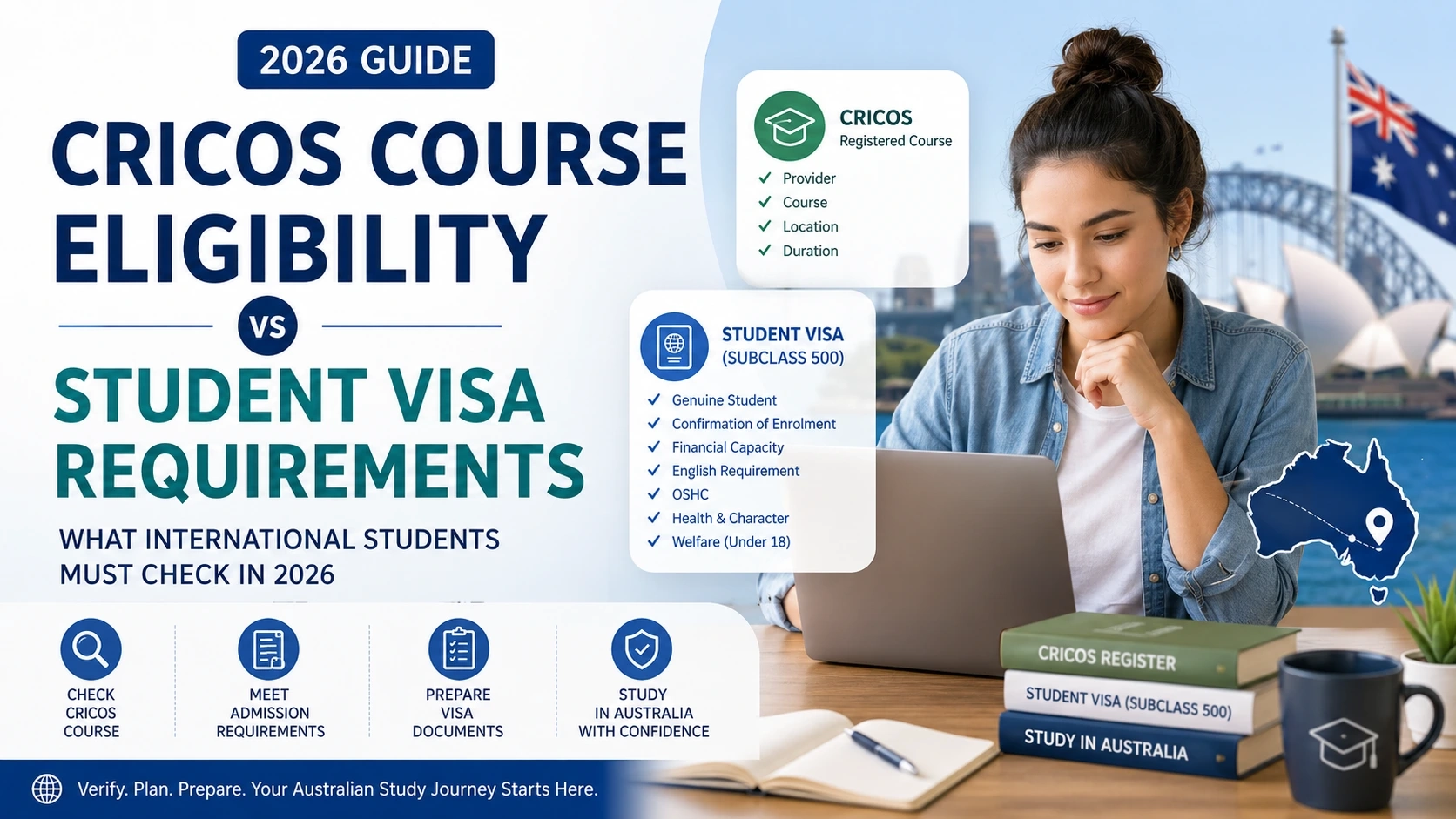
Choosing a CRICOS-registered course is only one part of becoming an international student in Australia. A course can be active on CRICOS, but that does not automatically mean that every applicant is eligible for admission or ready to apply for a Student visa. In 2026, students need to check two separate things: course eligibility set by the education provider and Student visa requirements set by the Australian Department of Home Affairs.
This distinction matters because many students search for “CRICOS eligibility” and expect one simple answer. In reality, CRICOS confirms that a course and provider are registered for overseas students, while admission requirements and visa requirements are assessed through different systems.
What does CRICOS actually confirm?
CRICOS stands for the Commonwealth Register of Institutions and Courses for Overseas Students. The official Australian Government CRICOS website states that it lists Australian education providers and registered courses available to people studying in Australia on student visas: https://cricos.education.gov.au/
A CRICOS course listing can help students verify important course-level information, such as:
- the provider name;
- the provider CRICOS code;
- the course name;
- the course CRICOS code;
- the registered location;
- the course duration;
- whether the provider and course are registered for international students.
However, CRICOS does not decide whether a student personally meets the provider’s admission requirements. It also does not grant Student visas.
That is why students should treat CRICOS as the first verification step, not the final eligibility check.
Course eligibility: what the provider checks
Course eligibility means the entry requirements set by the education provider. These requirements can vary widely depending on the provider, qualification level, field of study and course structure.
A provider may check:
- previous academic qualifications;
- English language level;
- minimum age;
- portfolio or audition requirements;
- relevant work experience;
- prerequisite subjects;
- professional registration requirements;
- interview or internal assessment results.
For example, an English language course, a Diploma of Business, a Bachelor of Nursing and a Master of Engineering may all be CRICOS-registered, but their admission requirements will not be the same.
Students should always check the provider’s official course page after finding the course in CRICOS. CRICOS confirms that the course is registered for overseas students; the provider confirms whether the student can be admitted.
Student visa eligibility: what Home Affairs checks
Student visa eligibility is separate from course eligibility. The Student visa is assessed by the Australian Department of Home Affairs under Subclass 500.
The official Student visa page says applicants must be enrolled in a course of study in Australia and hold a valid Confirmation of Enrolment, commonly called a CoE, when the visa is decided: https://immi.homeaffairs.gov.au/visas/getting-a-visa/visa-listing/student-500
Home Affairs may assess several visa-related requirements, including:
- Confirmation of Enrolment;
- Genuine Student requirement;
- financial capacity;
- English language evidence, where required;
- Overseas Student Health Cover;
- health checks;
- character requirements;
- welfare arrangements for students under 18;
- visa conditions and previous immigration history.
This means a student may receive an offer from a provider but still need to satisfy Home Affairs before a Student visa can be granted.
The Genuine Student requirement replaced GTE
One of the most important changes is the Genuine Student requirement.
From 23 March 2024, the Genuine Student requirement replaced the previous Genuine Temporary Entrant requirement for Student visa applications. Home Affairs states that the GS requirement applies to Student visa applications lodged on or after 23 March 2024: https://immi.homeaffairs.gov.au/visas/getting-a-visa/visa-listing/student-500/genuine-student-requirement
This is important because some older third-party pages still refer mainly to the old GTE framework or do not clearly explain the current GS requirement.
Under the Genuine Student requirement, applicants need to show that studying in Australia is their primary reason for applying for the visa. Home Affairs assesses whether the applicant is a genuine applicant for entry and stay as a student.
Students should not rely on outdated “eligibility” summaries that still focus on older visa language without mentioning the current GS requirement.
Confirmation of Enrolment: why CoE matters
A Confirmation of Enrolment is one of the central documents in the Student visa process.
Home Affairs states that Student visa applicants must hold a valid CoE when the visa is decided: https://immi.homeaffairs.gov.au/visas/getting-a-visa/visa-listing/student-500
There was also a specific policy change for onshore Student visa applications. From 1 January 2025, onshore applicants are required to include a CoE at the time of application. Home Affairs announced this change here: https://immi.homeaffairs.gov.au/news-media/archive/article?itemId=1283
This is another reason students should be careful with older articles. A Letter of Offer and a CoE are not the same thing. For visa purposes, students must follow the current Home Affairs rules.
English language requirements changed in 2024
English requirements can exist at two levels:
First, the provider may require a certain English level for admission into the course.
Second, Home Affairs may require English evidence for the Student visa application, depending on the applicant’s situation and the document checklist.
Home Affairs announced that from 23 March 2024, the minimum IELTS score required for a Student visa increased from 5.5 to 6.0, or equivalent. The minimum score for students undertaking an ELICOS course before their main course also changed: https://immi.homeaffairs.gov.au/news-media/archive/article?itemId=1188
Students should use the official Home Affairs Document Checklist Tool to check what evidence they need for their own application: https://immi.homeaffairs.gov.au/visas/web-evidentiary-tool
Financial capacity is a visa issue, not a CRICOS listing issue
CRICOS course search can help students find a registered course, but it does not prove that the student has enough funds for a visa.
Financial capacity is assessed by Home Affairs as part of the Student visa process. The official Student visa page should be checked before applying: https://immi.homeaffairs.gov.au/visas/getting-a-visa/visa-listing/student-500
Students should not assume that choosing a cheaper course automatically solves the financial requirement. Course fees, living costs, travel costs, dependants and length of stay can all affect the financial picture.
OSHC: health cover must match the visa period
Overseas Student Health Cover, usually called OSHC, is also part of the Student visa process.
Home Affairs explains that visa length is based on the course a student intends to study, and that the expiry date of OSHC is also taken into account. At minimum, OSHC must cover the course length: https://immi.homeaffairs.gov.au/visas/getting-a-visa/visa-listing/student-500/length-of-stay
This makes OSHC more than a small administrative detail. It can affect the practical visa timeline and should be arranged carefully.
Students under 18 need welfare arrangements
Students under 18 have additional requirements.
Home Affairs states that students under 18 must have welfare arrangements in place until they turn 18, even if they turn 18 before the course starts. Students must not enter Australia before their welfare arrangements start: https://immi.homeaffairs.gov.au/visas/getting-a-visa/visa-listing/student-500/welfare-arrangements-students-under-18
This is a good example of why “CRICOS eligibility” is too broad as a single concept. A CRICOS course can be registered, but a younger student may still need specific welfare documentation before a visa can be granted.
Why old CRICOS eligibility pages can mislead students
Some third-party pages about “CRICOS eligibility” are outdated because they describe older visa settings, mention COVID-era concessions, or fail to highlight the Genuine Student requirement introduced in 2024.
In 2026, a reliable student checklist should include:
- CRICOS course verification;
- provider admission requirements;
- Confirmation of Enrolment;
- Genuine Student requirement;
- financial capacity;
- English evidence;
- OSHC;
- health and character checks;
- under-18 welfare arrangements, where relevant;
- the official Home Affairs Document Checklist Tool.
A page that only gives a generic list of older requirements is not enough for serious decision-making.
Practical checklist before choosing a CRICOS course
Before applying for a course in Australia, international students should follow this order:
1. Find the course in CRICOS
Use the official CRICOS register or a faster CRICOS search tool to verify that the course and provider are registered for overseas students.
Official CRICOS website: https://cricos.education.gov.au/
2. Check the provider’s admission requirements
Go to the provider’s official course page and check entry requirements, English requirements, tuition fees, course duration, campus location and intake dates.
3. Confirm whether the course fits your visa plan
Check whether the course length, level and study pathway make sense for a Student visa application.
4. Review the Genuine Student requirement
Read the official GS requirement page before preparing your visa application: https://immi.homeaffairs.gov.au/visas/getting-a-visa/visa-listing/student-500/genuine-student-requirement
5. Use the Document Checklist Tool
Use the Home Affairs Document Checklist Tool to check what documents may be required for your situation: https://immi.homeaffairs.gov.au/visas/web-evidentiary-tool
6. Check the official Subclass 500 page before applying
Visa settings can change. Always check the official Student visa page before lodging an application: https://immi.homeaffairs.gov.au/visas/getting-a-visa/visa-listing/student-500
CRICOS eligibility: the correct way to understand it
The phrase “CRICOS eligibility” can be misleading if it suggests that one register decides everything.
A better way to understand the process is:
CRICOS registration confirms that the course and provider are registered for overseas students.
Course eligibility confirms whether the provider may admit the student.
Student visa eligibility confirms whether Home Affairs may grant the student a visa.
Students need all three layers to line up.
Final advice
Do not choose an Australian course based only on a course name, price or marketing page. Start by verifying the course in CRICOS, then check the provider’s entry requirements, then confirm the current Student visa requirements with Home Affairs.
In 2026, the safest approach is to treat CRICOS as the course verification step and Home Affairs as the visa authority. This helps students avoid outdated information, incomplete checklists and unrealistic study plans.